
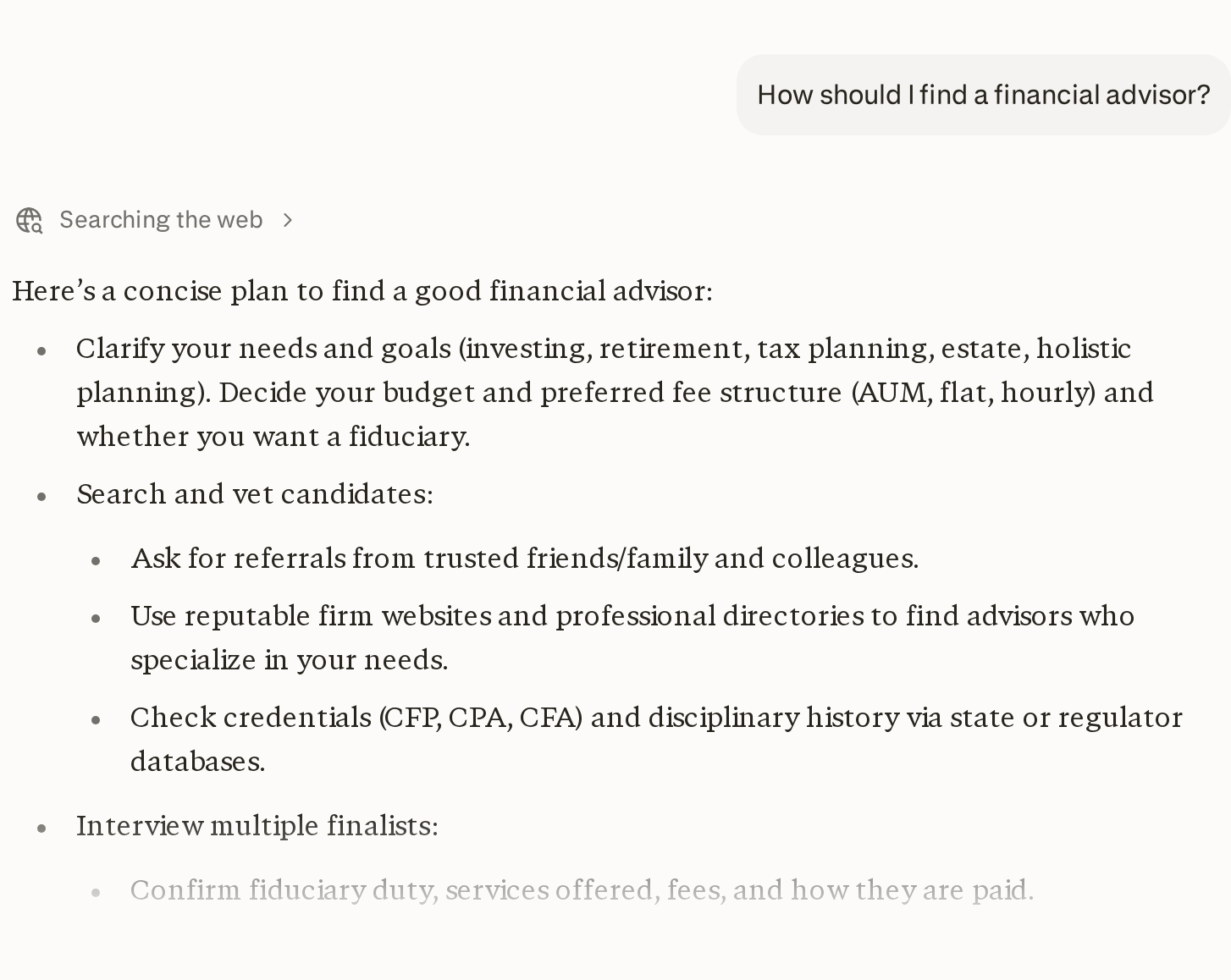
What the AI tells a prospect who asks how to find a financial advisor: referrals, directories, credential checks, interviews. Not one ad in the answer.
Your next prospect may never see Google — the share of prospects who ask AI first is growing fast. A mention in these answers can’t be bought, only earned.
You don’t have a lead problem — you have a lead quality problem
“How do I get more leads?” is the right starting question — but not the whole one
Ask most advisors how to grow, and the first answer is usually “get more leads.” It’s a reasonable answer — but it points at the wrong problem.
Chasing more leads is expensive and rarely delivers what advisors expect. Leads come in — but they don’t close, and the practice doesn’t grow.
The question was never wrong. It was just incomplete.
Same leads, different outcomes: why lead count doesn’t tell the whole story
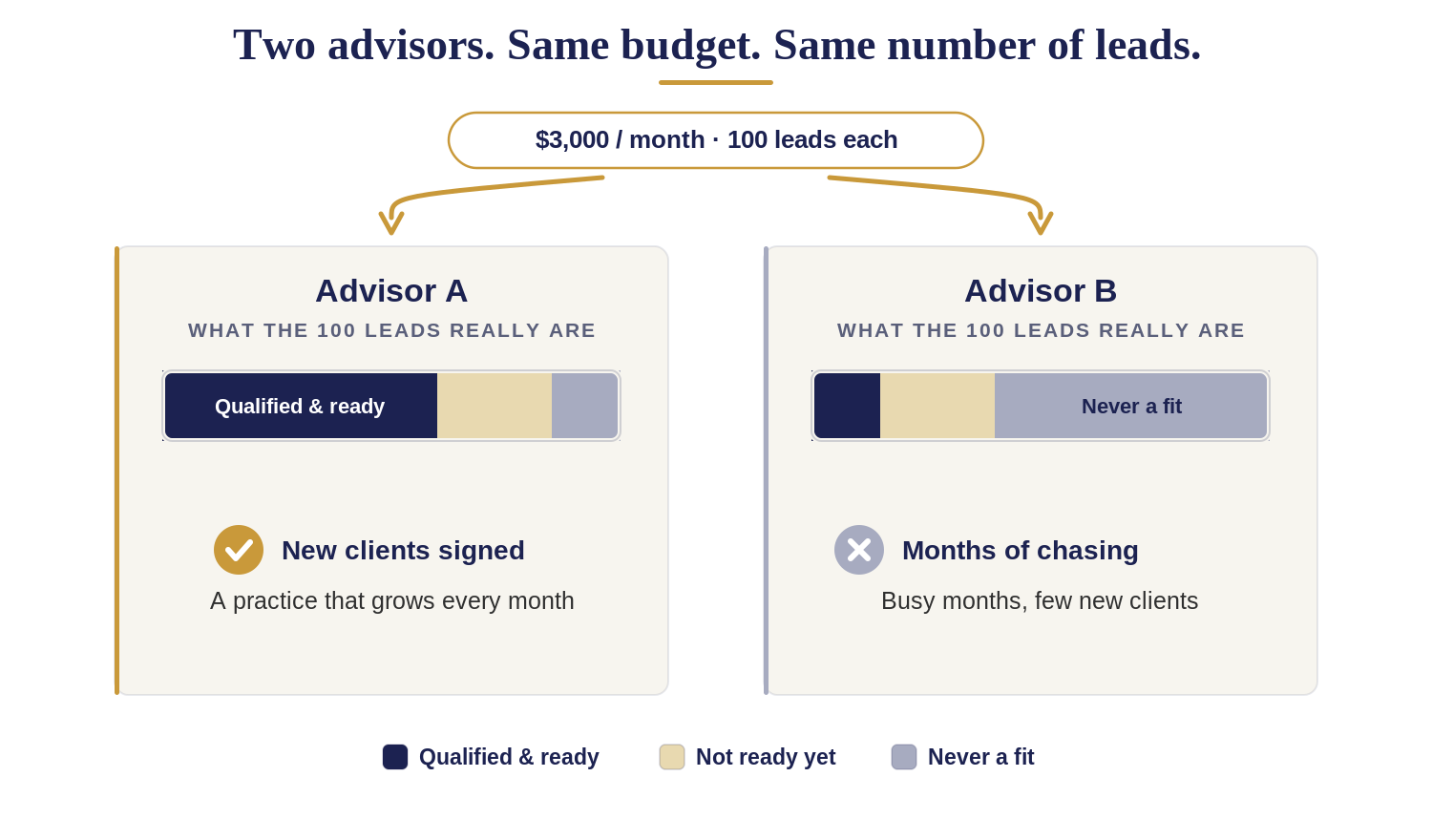
Two advisors can spend the same money and generate the same number of leads. One builds a thriving practice. The other chases prospects who never sign.
The difference isn’t lead volume. It’s what those leads are — whether they can become clients, or whether they filled out a form and forgot within five minutes.
Every lead has traits that predict whether they’ll sign, whether they’ll be a good fit if they do, and whether they’ll stick around long enough to matter.
Lead count doesn’t capture any of that. Cost per lead doesn’t either.
The frustrations behind the “I have leads but no clients” problem
You’ve probably felt this without naming it.
You buy leads from an aggregator, and they don’t remember signing up.
You run ads with no screening step, and the people who book calls have $80,000 saved and want free advice.
You get referrals — they’re great, but there are never enough, and referrals alone can’t grow a practice.
You try LinkedIn outreach, and the responses come from people trying to sell you something.
Every lead source has this pattern. Some are dominated by:
- People who aren’t ready to buy
- People without the assets to be your client
- People already talking to five other advisors
All of them look identical on your spreadsheet: a name, an email, a form submission. The differences only show up when you try to close them.
Seven dimensions separate a lead source that produces clients from one that produces noise
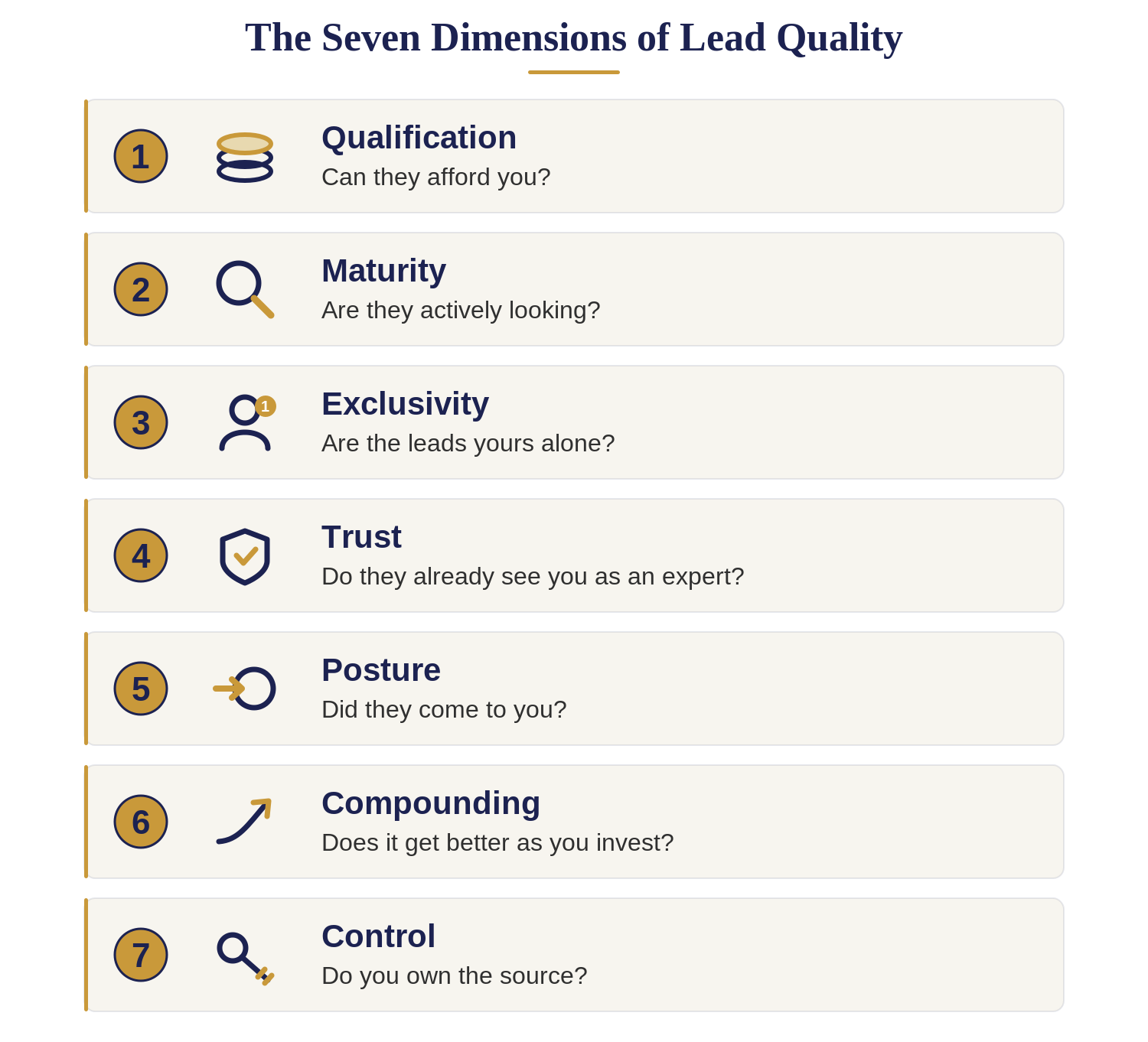
Every lead source can be scored on seven dimensions:
- Can its leads afford you?
- Are they actively looking for an advisor?
- Are they exclusive to you?
- Do they already trust you?
- Do they come to you — or do you chase?
- Does the source get stronger every month?
- Do you control the volume?
Score a source against those seven and you can see why the cheapest lead is often the most expensive way to sign a client — and why a source that feels slow to build becomes the foundation of a practice you can forecast.
And why the difference between advisors who grow predictably and advisors who are always hunting comes down to which of the seven work in their favor.
What we’ll cover: the seven dimensions, then every lead source scored against them
First, the seven dimensions, defined. Then every common lead generation method scored against each one — where it’s strong, where it falls short.
Finally, how to combine methods for your stage of practice — because no single lead source wins on every dimension. The strongest practices don’t pick one. They build a portfolio.
Lead quality, defined: the seven things that actually matter
Each dimension below is a question you can ask about any lead source. The answers predict — before you spend a dollar — whether a source will produce clients or noise.
Qualification: are the leads actually people who can afford your services?
Your practice has a minimum — $250K, $500K, whatever makes a client profitable. Qualification measures how many of a source’s leads actually clear it.
A lead below your minimum costs the same to work as one above it: the same calls, the same follow-up, the same no-shows. The revenue is zero.
A lead who can’t afford you isn’t a lead. It’s a cost.
Some sources filter for assets before you ever see the name. Others send you everyone who typed an email address.
Maturity: are they actively looking for an advisor, or just filling out a form?
Two people fill out the same form. One just retired with a $700K rollover decision to make this quarter. The other clicked a quiz during a lunch break.
Maturity is the difference. A mature lead is actively choosing an advisor. An immature one is just curious.
Immature leads aren’t worthless — they convert after months of nurturing, if you have a system for it. But if you count them as pipeline, your pipeline is fiction.
Exclusivity: are the leads yours alone, or are five other advisors calling them too?
Some vendors sell the same lead to three, four, five advisors. The lead’s phone starts ringing minutes after they submit the form — and keeps ringing for days.
A shared lead is a race, not a relationship. The winner is whoever calls first, not whoever fits best. And the prospect, annoyed by the fifth voicemail, often picks nobody.
An exclusive lead compares you to no one. A shared lead compares you to everyone who paid for the same name.
Trust: do they already see you as an expert, or are you a random name?
A prospect who’s read your articles, watched your videos, or sat in your seminar arrives half-convinced. A prospect who got your name from a list arrives suspicious.
Same person. Same assets. Completely different first meeting.
Trust decides what you’re selling on that call. With it, you’re confirming a decision. Without it, you’re overcoming a stranger’s defenses — and money is the last thing people hand to a stranger.
Posture: did they come to you, or did you have to chase them?
When you chase a prospect, you’re a salesperson. When they book a call with you, you’re the expert they hope has an opening.
Same service, opposite dynamics. Posture decides who’s convincing whom.
It shows up everywhere: chased prospects no-show more, negotiate fees harder, and take longer to decide. Prospects who came to you already decided you’re worth their time — that’s why they came.
Compounding: does the lead source get better as you invest, or stay flat forever?
Buy 20 leads this month, and next month you start at zero again. Same price, same quality, forever. That’s a flat source.
A compounding source improves as you invest: an article that ranks keeps producing leads for years, a funnel accumulates data that makes every ad dollar smarter, a happy client refers another.
Flat sources are rent. Compounding sources are assets.
Neither is wrong — flat sources deliver now, compounding sources deliver later. The mistake is building a practice on flat sources alone and wondering why growth never gets easier.
Control: do you own the lead source, or is a vendor between you and your pipeline?
A vendor can raise prices, tighten territories, or shut down — and your pipeline goes with it. That’s what it means to not control your lead source.
Control means the asset is yours: your website, your funnel, your email list, your ad accounts, your data. Nobody can turn it off, reprice it, or sell it to your competitor.
The question isn’t whether vendors are bad. It’s what happens to your practice the day one changes its terms — and whether you’d have anything left.
Buying leads: the shortcut that becomes the trap
Buying leads looks like the rational choice: pay today, get names today. The trap isn’t the leads themselves — it’s what the spending doesn’t build.
Buying leads and building your own client acquisition can share the same monthly budget
A $2,000–$3,000 monthly budget buys a batch of shared leads from an aggregator — names that run roughly $80–$300 each when the prospects have real assets. And per-lead buying is disappearing: SmartAsset, the biggest aggregator, now sells annual subscriptions that start around $25,000 a year.
The same budget funds a dedicated funnel with ads behind it: a landing page built for your niche, qualification built into the form, and traffic you control.
This isn’t a cheap option versus an expensive one. It’s the same money buying two different things. One buys this month’s names. The other builds an asset that produces clients.
The budget question was never “can I afford to build my own channel?” It was “what is my budget currently buying?”
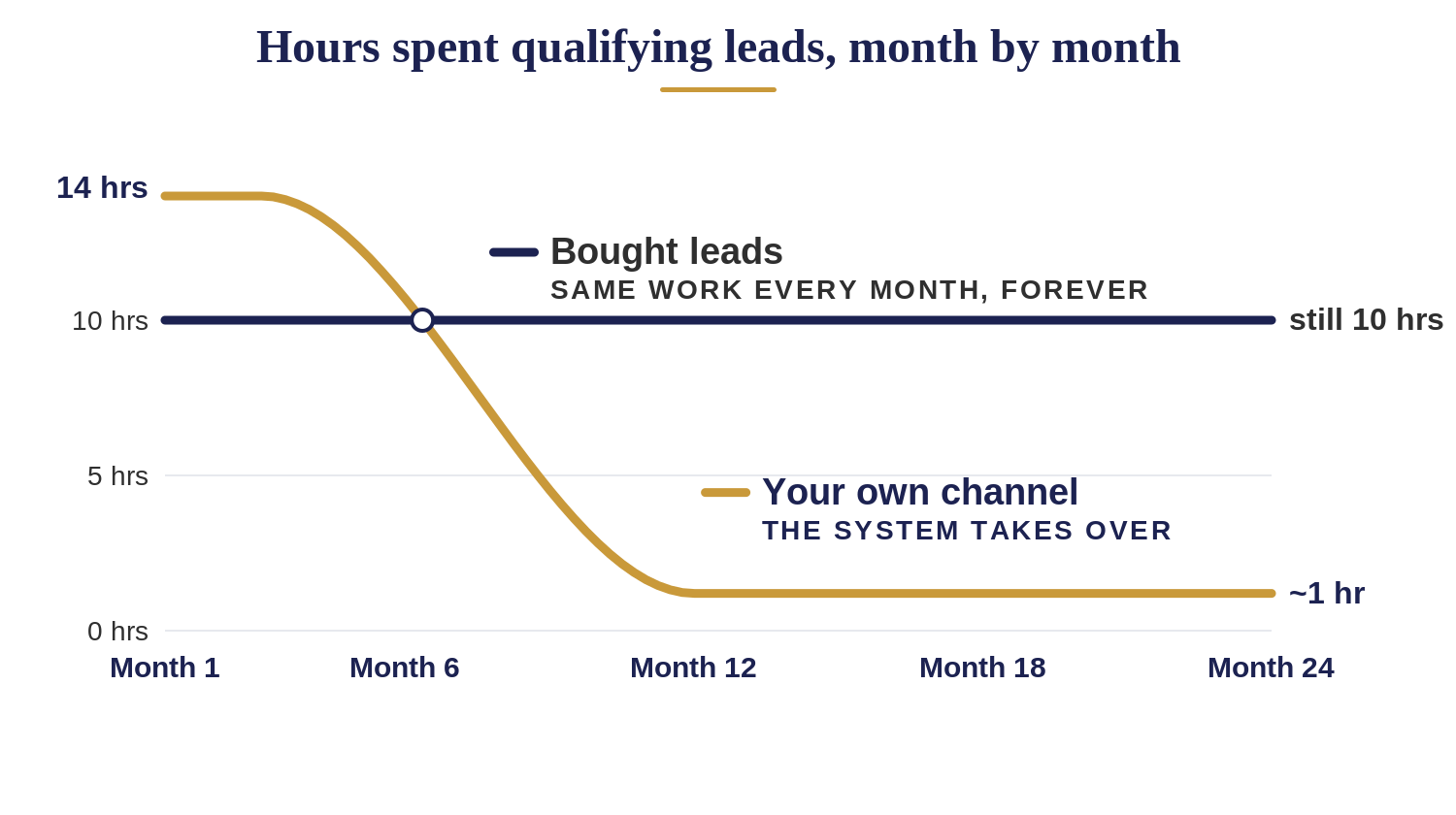
The time you spend qualifying bad bought leads never stops — the time you spend building your own client acquisition channel eventually does
Every batch of bought leads needs the same work: call fast before four other advisors do, weed out the ones who don’t remember the form, the ones under your minimum, the ones collecting free advice. Fifteen names might yield two real conversations.
That work repeats every month, forever. Month 24 of buying leads looks exactly like month 1.
An owned channel front-loads the work instead. Building the funnel, tuning the targeting, sharpening the qualification questions — that’s real effort, and it takes months. But every improvement stays improved. The system starts qualifying so you don’t have to.
Six months in, one path produces better clients at lower cost — the other still delivers the same low-quality leads at the same price
Six months of buying leads: same price per name, same shared lists, same 1-to-3-percent close rate. Nothing accumulated. Stop paying and the pipeline stops the same day.
Six months of an owned channel: the funnel has data — which hooks pull $500K+ prospects, which keywords waste money, which qualification questions filter best. Cost per qualified appointment falls as the data compounds. Stop the ads and the funnel, the data, and the content are still yours — ready the day you restart.
Side by side:
| After six months | Buying leads | Your own channel |
|---|---|---|
| What you own | Nothing — the vendor owns the source | The funnel, the data, the audience |
| Cost per client | Same as month 1 | Falling as targeting sharpens |
| Lead quality | Same shared names | Improving with every data point |
| If you stop paying | Pipeline stops that day | The asset remains |
Bought leads still have a role: filling this month’s calendar while an owned channel ramps up. The trap is treating them as the strategy instead of the bridge.
Which lead sources bring you your ideal clients consistently — and which bring you noise
Referrals, bought leads, seminars, webinars, cold outbound, paid ads, content, AI assistants. None is good at everything — the point is knowing what each gives you and what it quietly costs.
Referrals from clients: high on quality and trust, but you can’t turn the tap
A referred prospect arrives pre-qualified — wealthy people know wealthy people — and pre-sold, because someone they trust vouched for you. Best leads in the business.
The problem is everything else. You can’t schedule referrals, can’t scale them, can’t make them happen this quarter. The best lead source you have is also the one you control least.
Buying leads from aggregators: fast to start, weak on almost every quality dimension
The good platforms filter by assets, so qualification is real. Everything else leaks: the lead is shared with multiple competing advisors, arrived through a comparison site, has never heard of you, and gets chased by everyone who paid.
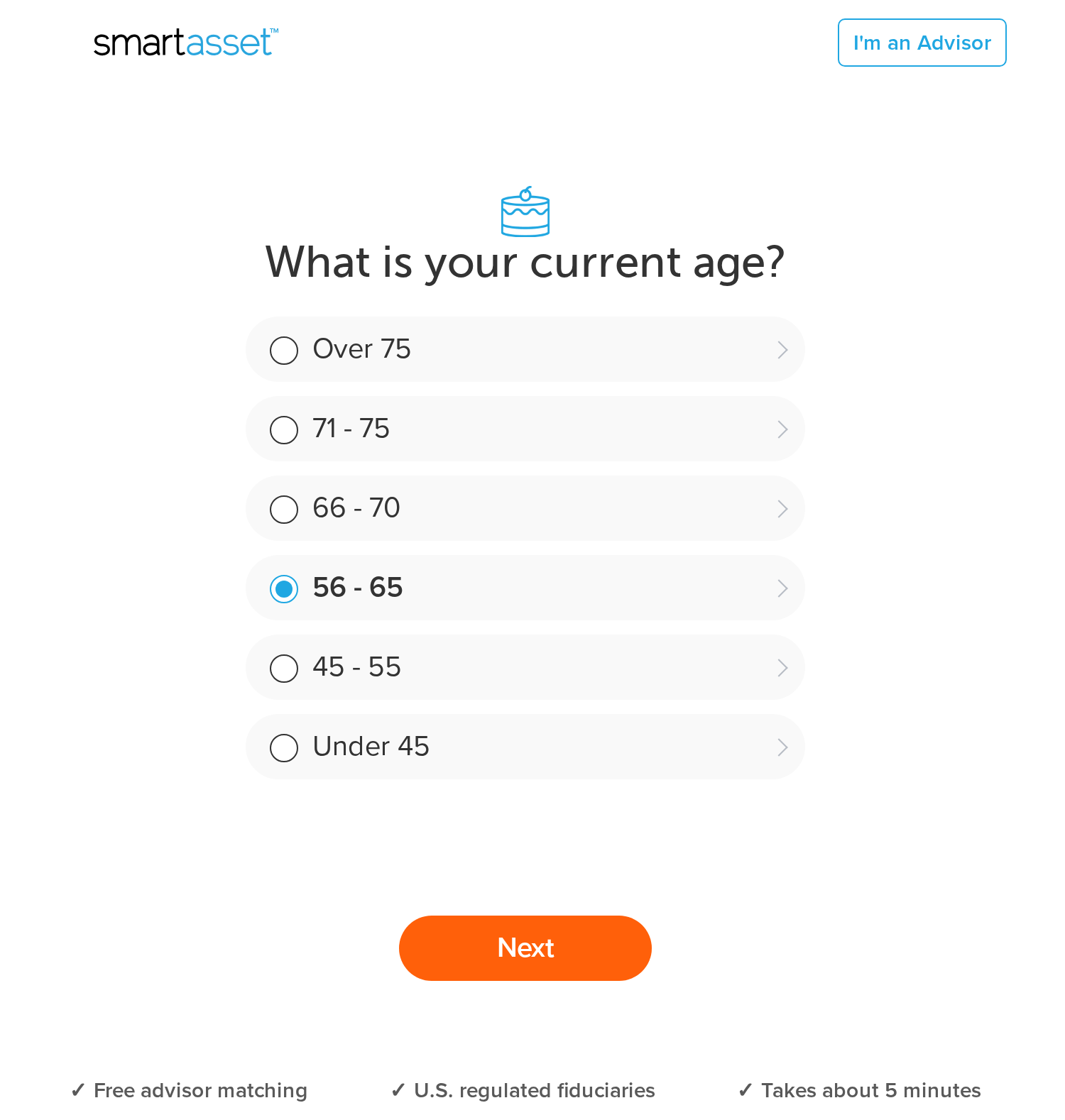
Where your bought lead started: SmartAsset’s matching quiz. Five minutes of questions, and the process ends with up to three competing advisors getting the phone number. The 56–65 bracket comes pre-selected.
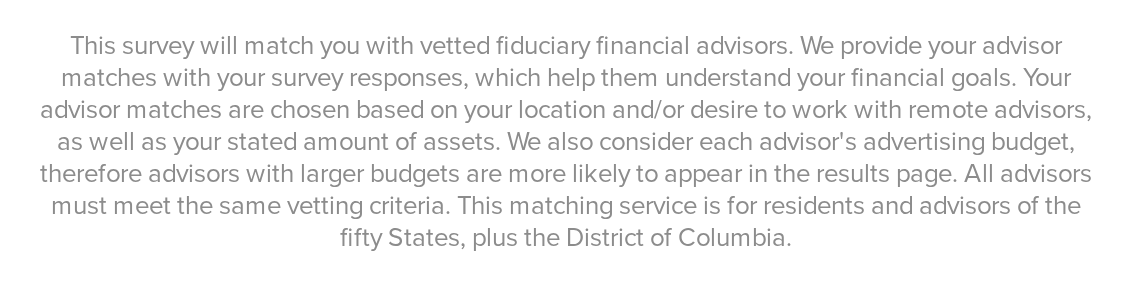
The fine print at the bottom of SmartAsset’s own matching quiz page: “We also consider each advisor’s advertising budget, therefore advisors with larger budgets are more likely to appear in the results page.”
Speed is the product. Quality is the tradeoff.
Seminars and educational events: strong trust and posture, hard to scale
A room of prospects watching you teach for an hour builds more trust than any ad can. They chose to come, they’ve seen you think, and the ones who book afterward arrive convinced.
The limits are physical. Each event costs money and an evening, fills from the same local pool, and starts from zero next month. Trust builds in the room — but nothing accumulates outside it.
Webinars: seminar trust without the room — and the replay keeps working
Everything a seminar builds — an hour of prospects watching you teach — without renting a room or being limited to one town. Your niche can attend from anywhere, and the registration form asks the screening questions before anyone shows up.
A webinar also leaves two things behind that a seminar doesn’t: a recording — people watch the replay weeks later and still book calls — and an email address for every registrant, including the ones who never showed up.
The catch: a webinar fills nothing by itself. Something has to fill the webinar — ads, LinkedIn, your list. It’s a converter of attention, not a source of it.

A LinkedIn ad filling a webinar — the paragraph above, in practice. The topic is built for one company’s workforce: nobody registers for a P&G Medicare session by accident, so every name on the list is exactly who the firm wants to meet.
Cold outbound (email, calls): full control and exclusivity, but starts you in the weakest posture
You choose the exact niche, assets, and firm size you want — and nobody else is calling your list. All at near-zero cost. The list is yours, the timing is yours, the volume is yours.
What you can’t pick is how it feels on the other end: a stranger asking for attention. Every conversation starts with you selling and them screening. Trust is zero at first touch, and most prospects weren’t looking.
Google Ads to your own funnel: catches leads at high maturity, expensive if nothing sets you apart
Someone searching “financial advisor near me” is a prospect at peak maturity — actively choosing an advisor this month. Google Ads catches that moment at scale, exclusively, on a funnel you own.
The cost is real: competitive advisor keywords run $15–$40 a click in major metros — several times the $3–4 average across finance. Without a screening step and a page that sets you apart, you pay those prices for anyone who clicks. With them, the data compounds — every month of spend teaches the funnel who your client is.

Running right now: EP Wealth’s free retirement guide, offered at the moment the person is already searching — and “For investors with $1M+” in the ad text guards every $15–$40 click.
Meta Ads to your own funnel: cheap traffic, low maturity, requires nurturing to convert
Meta reaches your target clients for a fraction of Google’s click prices and targets them precisely. The catch: nobody on Facebook is searching for an advisor. You’re interrupting, not answering — so leads arrive curious, not shopping.
That’s workable with a nurture system: a free guide worth trading an email for (called a “lead magnet”), an email sequence, patience. Without one, cheap leads become expensive silence.
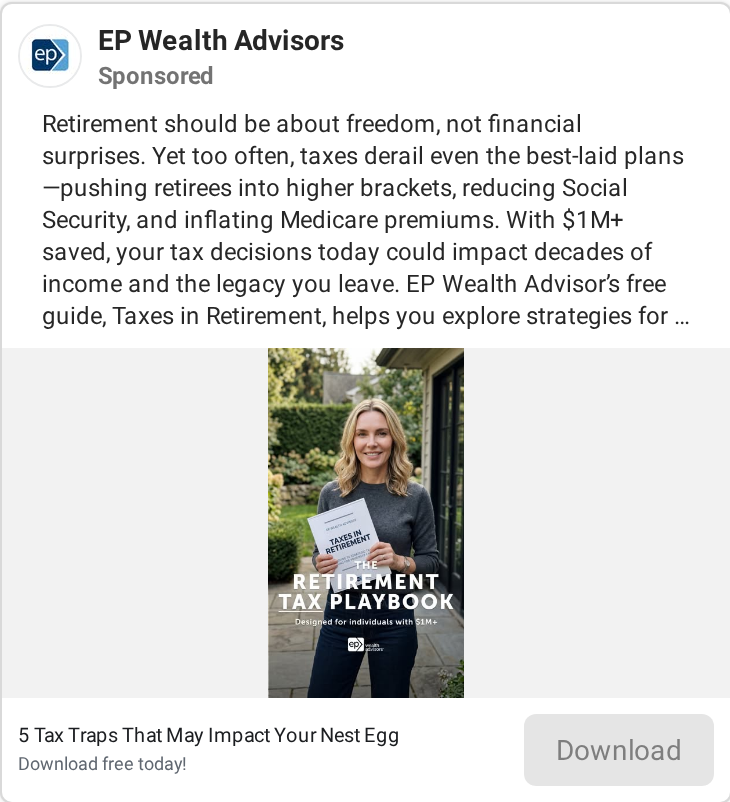
What a strong Meta ad looks like: the first word is “Retirement” — the reader’s own subject; the photo is a real person holding a real guide; and it asks for a download, not a meeting. The “$1M+” on the cover keeps the wrong clicks away.
LinkedIn Ads to your own funnel: precise professional targeting, expensive per click
No other platform can target “business owners, 55+, manufacturing, $5M+ company.” If your niche maps to a job title, LinkedIn Ads reaches exactly them.
You pay for the precision — clicks average $5–$7 and climb past $10 for senior titles — and the audience isn’t in advisor-shopping mode. Precision without maturity: right people, wrong moment. Best for niche practices where the targeting is the whole game.

The same firm and the same free guide as the Google and Meta ads above — the “$1M+” filter traveling along. Three ad platforms, one guide: that’s a stack in practice.
LinkedIn organic content and outreach: strong for trust building, weak for consistent volume
Posting real expertise where your prospects and referral partners can see it builds trust before any conversation happens. When someone messages you after reading your posts for three months, they arrive half-closed — they came to you, zero ad spend.
The weakness is rhythm: reach depends on the algorithm, growth takes months of consistency, and volume never becomes predictable. A credibility engine, not a pipeline.
SEO and content marketing: strong on almost every dimension, slow to build
A ranked article catches people actively searching, builds trust as they read, delivers them exclusively to you — and they came to you. It keeps doing that for years.
The price is time. Fewer than 2% of newly published pages reach Google’s top ten within a year — plan on six to twelve months of consistent publishing before organic traffic amounts to anything.
AI assistants (ChatGPT, Claude, Perplexity): the newest place prospects ask, and the youngest channel you can buy
A growing share of prospects now ask an AI assistant instead of Google: “how do I find a fiduciary advisor?” When the answer names you, that prospect arrives with borrowed trust — the assistant recommended you, and they came to you.
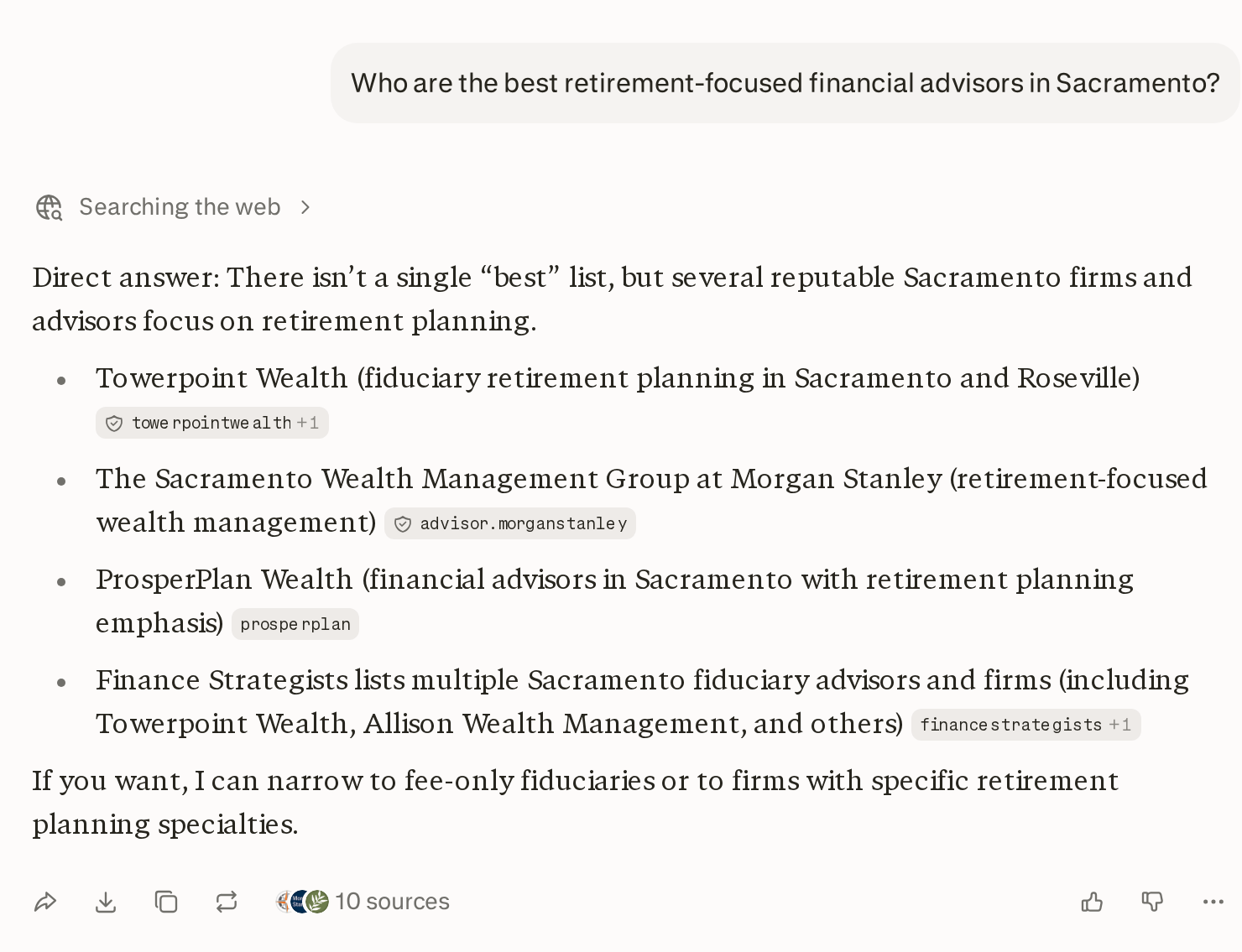
A prospect asks in their own city. The first name is an independent local firm — above a Morgan Stanley group — because its website and directory profiles gave the AI something to cite.
The organic mention can’t be bought — only earned, with citable content and a consistent reputation across the web. Paid placement arrived in 2026: ChatGPT now runs ads under its answers — putting you inside the conversation where a prospect is choosing an advisor, at a moment Google never sees, because the question was never typed into a search bar.
The catch: volume. The channel is growing fast, but today it’s still a fraction of Google’s. High trust, early days.
The Pre-Retiree Client Engine: our dedicated client acquisition funnel, designed to hit every dimension
The Pre-Retiree Client Engine is the client acquisition system we build at Ultima Sourcing. The system works for any niche an advisor serves — we named it for the one where we’ve applied it most successfully: high-net-worth pre-retirees and retirees.
It’s five pieces working as one:
- One niche where your expertise runs deepest. Not “anyone with money” — one audience, so the ads speak their language and the page answers their questions.
- Ads that put you in front of your niche. Google catches people actively searching; Meta and LinkedIn reach the right profiles before they search.
- A page and video built only for your practice. Prospects read your positioning and watch you speak before they book — doubt about your competence is off the table.
- Qualified prospects book your calendar directly. A screening form keeps the unqualified off it — and nobody gets chased.
- Follow-ups that keep the not-ready-yet warm. Leads who don’t book aren’t lost — they hear from you until the timing is right.
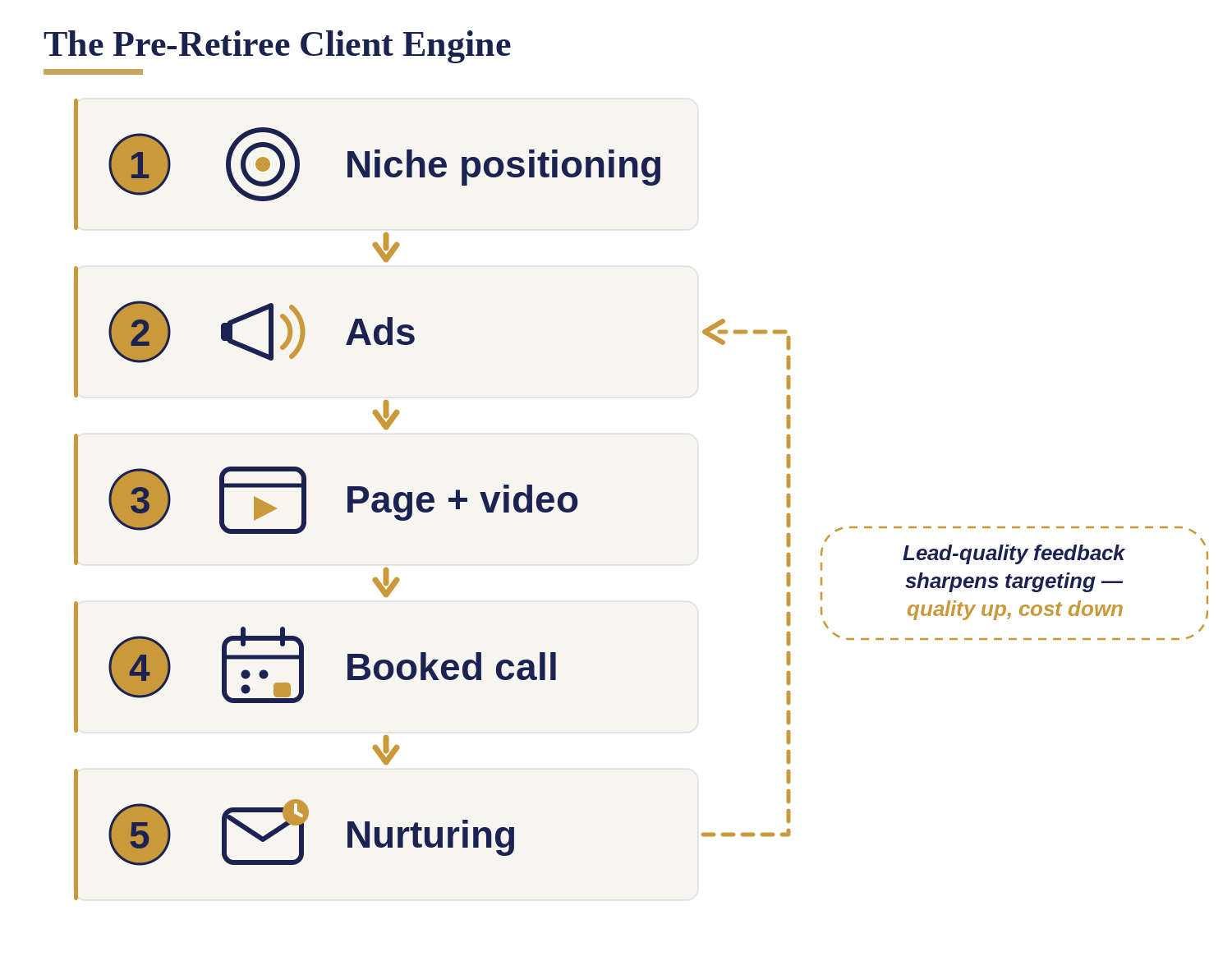
Prospects show up to the first call already knowing who you are — it feels like a second conversation, not a cold pitch. And every lead’s outcome feeds back into the targeting: lead quality compounds while cost per appointment falls.
It’s the only option engineered to be good at everything. The honest cost: months of building and tuning before it hums, and either the time to learn the craft or the budget to hire it.
All twelve lead generation methods in one table: where each is strong, where each falls short
| Lead source | Strong on | Weak on |
|---|---|---|
| Referrals | Qualification, maturity, exclusivity, trust, posture | Compounding, control |
| Bought leads | Qualification (filtered platforms) | Maturity, exclusivity, trust, posture, compounding, control |
| Seminars | Qualification, trust, posture | Compounding, scale |
| Webinars | Qualification, trust, posture, compounding (replay + list) | Maturity, control |
| Cold outbound | Qualification, exclusivity, control | Trust, posture, maturity |
| Google Ads + funnel | Maturity, exclusivity, control, compounding (with a system) | Trust at first click |
| Meta Ads + funnel | Exclusivity, control, compounding | Maturity, trust, posture |
| LinkedIn Ads + funnel | Qualification, exclusivity, control | Maturity, trust, posture, click costs |
| LinkedIn organic | Trust, posture, compounding | Control, predictable volume |
| SEO & content | Maturity, trust, exclusivity, posture, compounding, control | Time to results |
| AI assistants | Maturity, trust, posture, compounding (earned) | Control, predictable volume |
| Pre-Retiree Client Engine | All seven: qualification, maturity, exclusivity, trust, posture, compounding, control | Months to build |
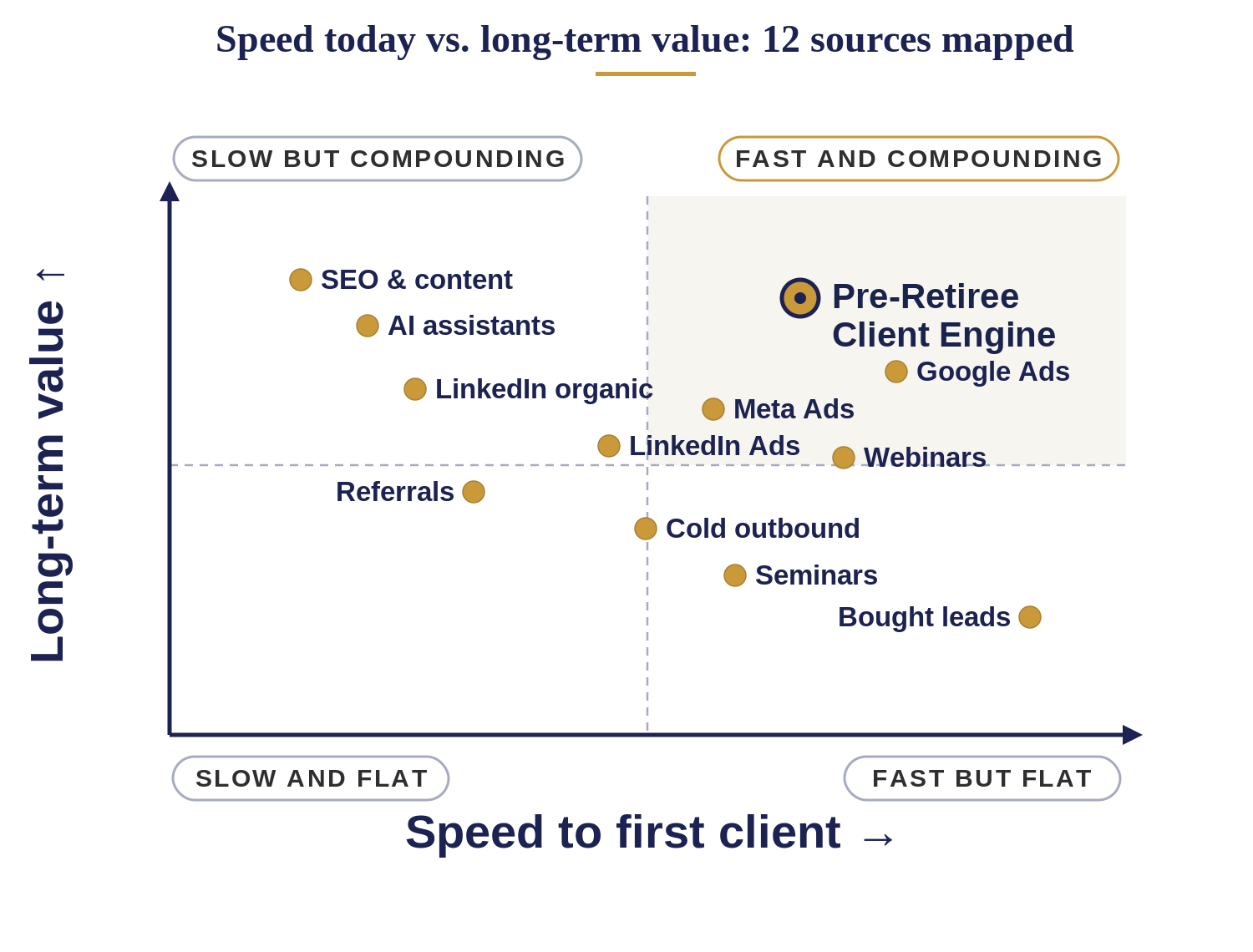
Fast usually means flat; lasting usually means slow. Only the Pre-Retiree Client Engine sits in the top right — and it can’t be bought, only built.
No single lead source is enough — here’s how to combine them
The table above points to one conclusion: no source deserves your whole budget. The question is which combination — and that depends on what you already have.
Strong practices run three or four sources together — chosen so their weaknesses cancel out
A strong stack covers three jobs: appointments this month, trust that builds over time, and clients who arrive pre-sold. The first two can be built from day one — the third is earned.
Two example stacks, one for each starting point:
Example 1 — starting from scratch, a solo practice:
- Google Ads feeding your own Pre-Retiree Client Engine — the fast source: booked calls while everything else is still growing. A solo advisor builds the lean version of the Engine; practice size changes how much you hire out, not whether you need one.
- LinkedIn organic in your niche — posts that build recognition, so prospects who click your ad already know your name.
- Cold outbound in your niche — costs time instead of budget and works from the first week; your LinkedIn presence answers the “who is this?” lookup.
Cold outbound carries the volume until referrals take the pre-sold job. They join the stack with your first signed clients: every client gets asked.
Example 2 — clients already flowing, an established practice:
- The Pre-Retiree Client Engine — the volume you control month to month.
- SEO and content marketing — the slow asset that reduces the dependence on paid clicks, and the same pages AI assistants cite.
- Referrals — keep the quality baseline you already have.
The weaknesses cancel because the jobs differ.
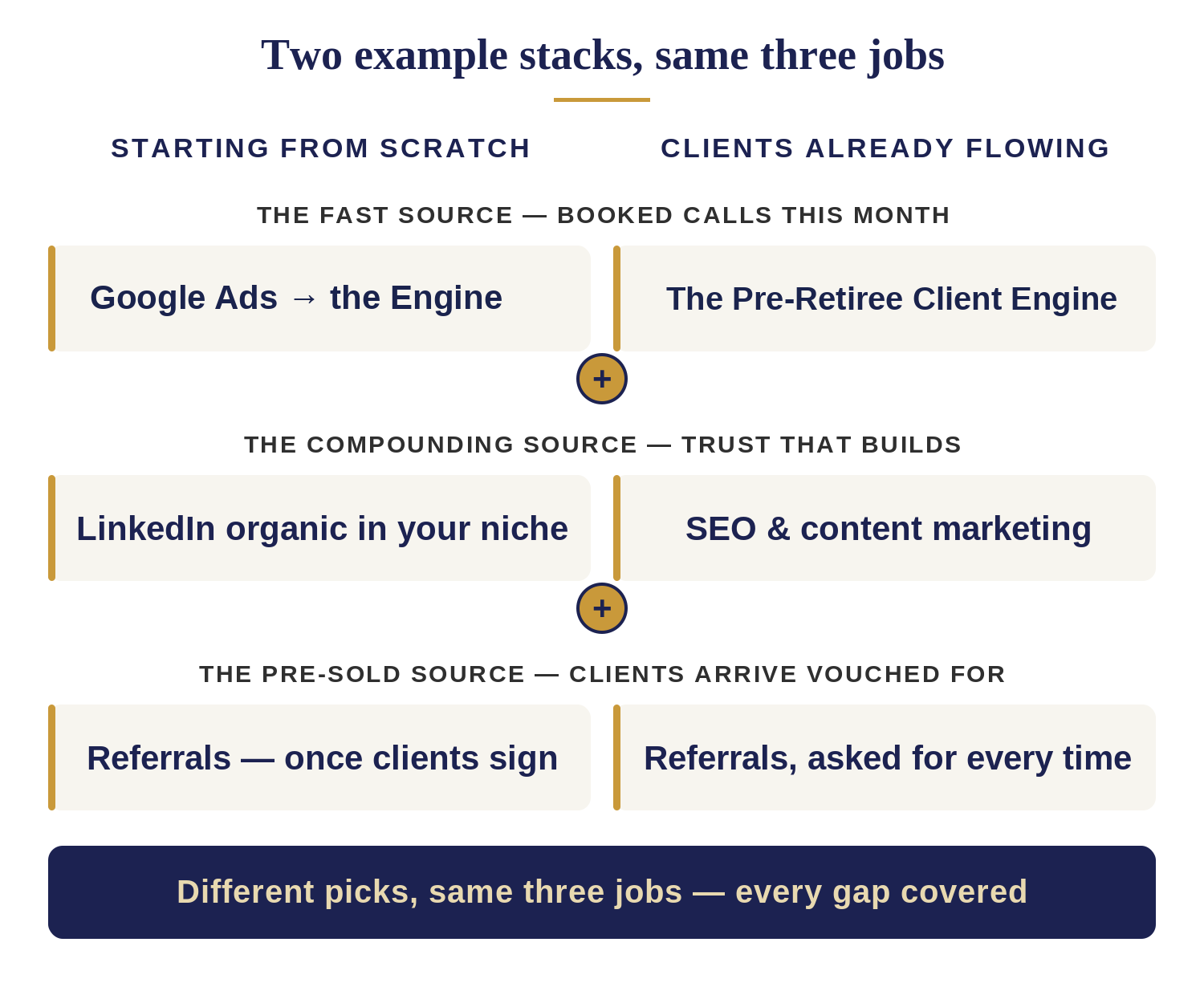
Three sources isn’t three ad budgets. In each stack only one runs on paid traffic — the other two are built, not bought.
Build around one channel you own that improves every month — and fill the gap with fast sources while it grows
An anchor is a channel where this month’s work makes next month better: more data, better rankings, sharper targeting. Three qualify:
- The Pre-Retiree Client Engine — compounds through ad data; typically the fastest of the three to start paying, months rather than years
- SEO — the strongest long-term profile of any source; six to twelve months of consistent publishing before traffic amounts to anything
- Earned AI mentions — the same content that earns rankings earns these; the channel is young, but it’s the fastest-growing way prospects now find advisors
All three are slow at first. That’s the price of anything you own.
That’s what the fast sources are for: bought leads and outbound deliver appointments now, while the anchor grows. Month 1, most of your budget feeds the fillers. Month 12, most feeds the anchor — because it got cheaper while the fillers stayed flat.
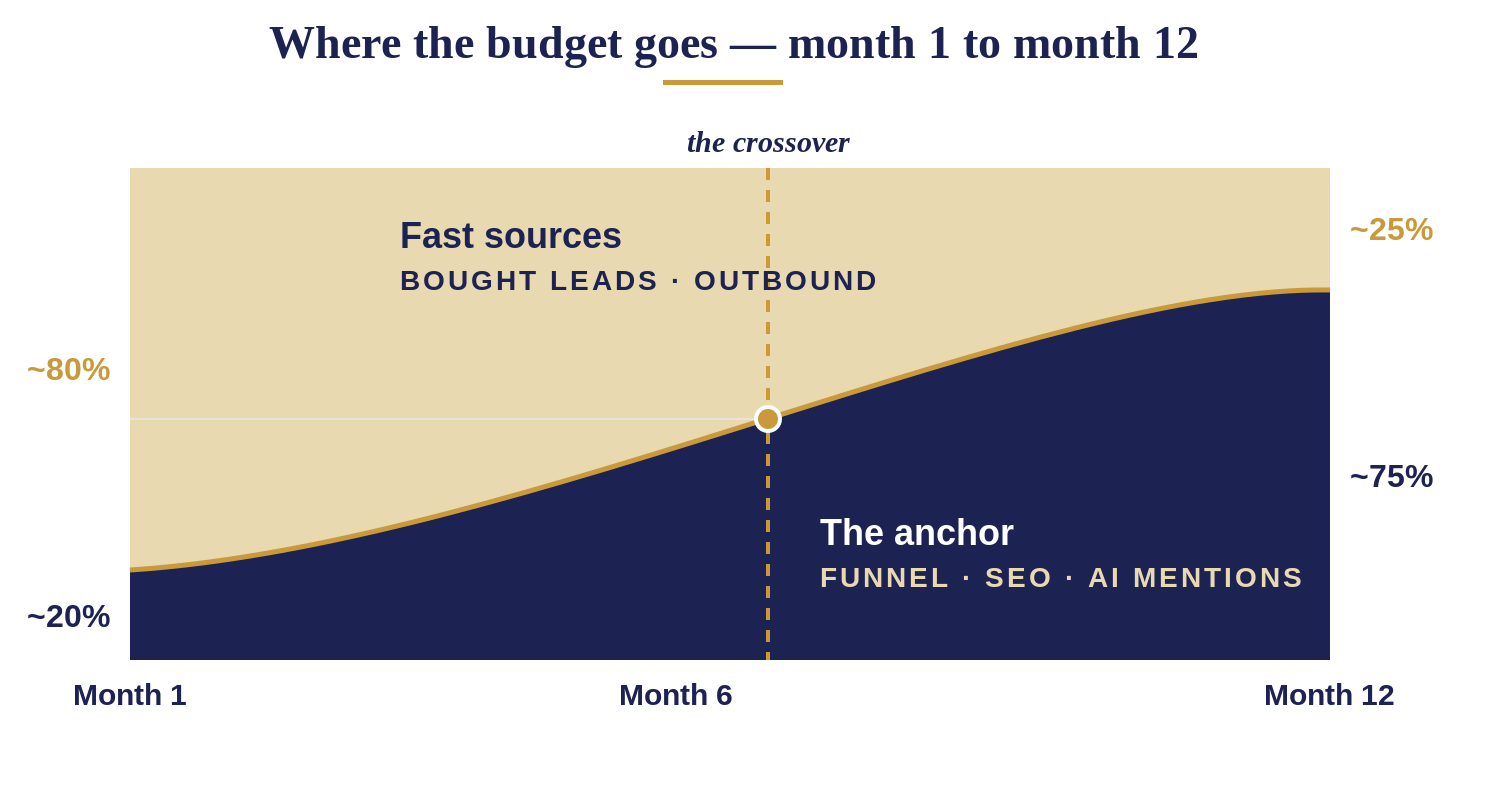
Where solo advisors go wrong: stacking quick sources that stay flat forever
$2,500 a month split between bought leads and a quarterly seminar feels productive — appointments happen, the calendar isn’t empty.
Two years later the math hasn’t moved: same cost per client, same shared leads, nothing owned. Stop spending and everything stops.
The fix isn’t more budget. It’s pointing a slice of it — money or hours — at something you own, early. Flat wins the quarter. Compounding wins the year.
Where established advisors go wrong: leaning on referrals and ads with nothing they own building trust
A practice with real AUM usually runs on referrals plus some ads an agency manages. It works — until it wobbles: referrals can’t be scheduled, and ads with nothing building trust behind them get more expensive every year.
The missing piece is the owned trust asset — the positioning, video, and content that make prospects arrive half-convinced. It turns ad clicks into booked calls, and referrals into faster closes.
Practice size changes how much of this you hire out — not whether you need to own it. A solo advisor builds a lean version. A large practice pays specialists. The machine is the same.